Monday, January 28, 2013
Outstanding Employment Opportunities
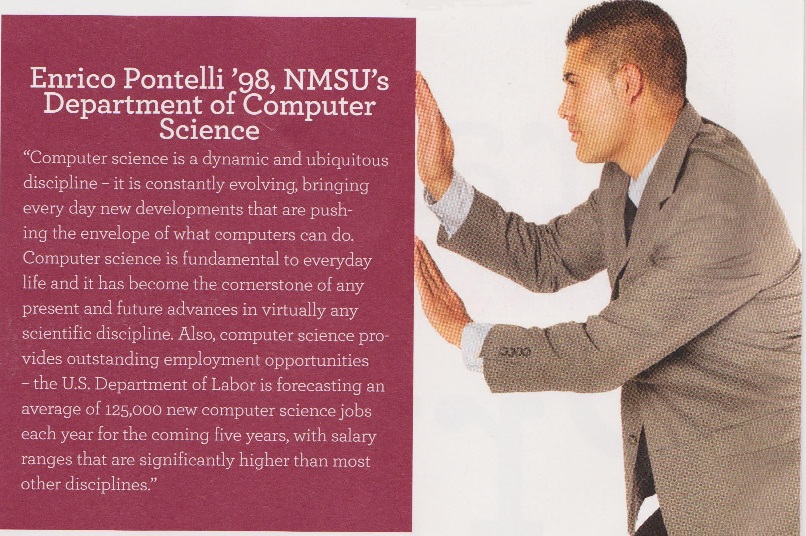
In the Aggie Panorama it was reported that new computer science jobs would be abundant with high salary ranges.

Wednesday, January 2, 2013
Physical Disability and Assistive Tech in Media
Happy New Year to one and all from all of us at Project Enable. I'm not sure what New Year's looks like in PA, but here in New Mexico it mostly involves fireworks and time with friends. I'd imagine it's something similar in the North East.
 We've been on a holiday break for the past week and a half, and are back and ready to get busy recruiting mentors (for both PA and NM), and participants (just NM this time). During the break I got the chance to catch up on my movie watching, and something caught my eye...most movies that come out today don't have physically disabled people shown very often...at least not the way that they are usually portrayed.
 See, I'm learning more and more that people who don't have a disability (myself included) seem to make snap judgements about people using crutches or rolling through life in a wheelchair. These assumptions are usually wrong, and I am not sure where they all come from. Movies, in the past, that have had physically disabled characters in them don't usually show them in a positive light. They are usually slower, and often, aren't main characters. The only time we see a main character who is disabled, it's a retailing of someone's actual life story..."the exception rather than the rule" kind of mentality.
But, I'm noticing something different happening, and it's encouraging to see. More movies are being made with and about disabled individuals. "Hyde Park on the Hudson" is about FDR and shows how his disability didn't stop him from living (even if he did try to hide it from the public). Then there are movies like "The King's Speech"...not specifically about a physically disabled person, but more about a friendship between two people.
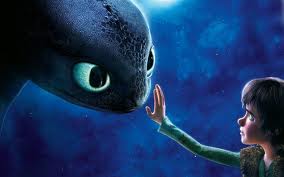
 But I'd have to say my personal favorite movie, that also highlights assistive technology, would have to be "How to Train Your Dragon". Upon first glance, this isn't a movie about physical disability at all, and that is partly why it is a great movie about physical disability. Three characters use assistive tech on a daily basis, but that's not what defines them. Gobber has a multi-purpose prosthetic arm and a prosthetic leg. Toothless, the dragon, needs a replacement tail fin to fly properly. And (not to give too much away for those of you who haven't seen the movie) Hiccup requires assistive tech as well. If you haven't seen it, I encourage you to take a look. It's a good movie, and an encouraging one as well.
 All these characters are so much more than their disabilities or their tech. And that's what good technology should be...not surpassing the individual, but rather, surpassing the way people see them.
 And that's what we hope to show you all through our Technology nights, as well as encourage each participant to look into AT in greater detail. What could you create with the right opportunities...and nothing opens doors like a 4 year degree in Science, Technology, Engineering, or Mathematics.
 We've been on a holiday break for the past week and a half, and are back and ready to get busy recruiting mentors (for both PA and NM), and participants (just NM this time). During the break I got the chance to catch up on my movie watching, and something caught my eye...most movies that come out today don't have physically disabled people shown very often...at least not the way that they are usually portrayed.
 See, I'm learning more and more that people who don't have a disability (myself included) seem to make snap judgements about people using crutches or rolling through life in a wheelchair. These assumptions are usually wrong, and I am not sure where they all come from. Movies, in the past, that have had physically disabled characters in them don't usually show them in a positive light. They are usually slower, and often, aren't main characters. The only time we see a main character who is disabled, it's a retailing of someone's actual life story..."the exception rather than the rule" kind of mentality.
But, I'm noticing something different happening, and it's encouraging to see. More movies are being made with and about disabled individuals. "Hyde Park on the Hudson" is about FDR and shows how his disability didn't stop him from living (even if he did try to hide it from the public). Then there are movies like "The King's Speech"...not specifically about a physically disabled person, but more about a friendship between two people.
 But I'd have to say my personal favorite movie, that also highlights assistive technology, would have to be "How to Train Your Dragon". Upon first glance, this isn't a movie about physical disability at all, and that is partly why it is a great movie about physical disability. Three characters use assistive tech on a daily basis, but that's not what defines them. Gobber has a multi-purpose prosthetic arm and a prosthetic leg. Toothless, the dragon, needs a replacement tail fin to fly properly. And (not to give too much away for those of you who haven't seen the movie) Hiccup requires assistive tech as well. If you haven't seen it, I encourage you to take a look. It's a good movie, and an encouraging one as well.
 All these characters are so much more than their disabilities or their tech. And that's what good technology should be...not surpassing the individual, but rather, surpassing the way people see them.
 And that's what we hope to show you all through our Technology nights, as well as encourage each participant to look into AT in greater detail. What could you create with the right opportunities...and nothing opens doors like a 4 year degree in Science, Technology, Engineering, or Mathematics.
Wednesday, December 19, 2012
Webinar 1: The Status of Persons with Disabilities in Science, Technology, Engineering and Math: Where Are They?
Where is everyone? Or rather, where is the disabled population? It's not something that most people think about, is it? Especially when walking into an engineering firm, or computer science department at a university, and yet....they are no where to be found. We wanted to understand why that is, and what the United State's statistics say about this apparent gap.
So, on Wednesday, December 12, 2012, Dr Jeanine Cook hosted a webinar (via Google Hangouts) to discuss the situation. And what she found was very interesting. Let's start with "how do you define disability". It doesn't sound like a hard question, but there doesn't seem to be an easy answer. For, (almost) every source Dr Cook found, a different definition for disability was used. How can statistics be accurate when the same pool of people changes each time?
What was found is that the limited numbers of disabled individuals going to university usually go into 2 year programs. While there is nothing wrong with this, the fact is that the better jobs are saved for those with 4 year degrees.
Dr Cook then looked into why this is...why are most disabled people not going to college, and when they do, why are they choosing to only get an associates degree. There were a few possible reasons, but the one that was staring us in the face was that most disabled people are (either intentionally or unintentionally) being discouraged from doing anything. As a group of people, they are being told that it would be better for them to just live on governmental assistance.
We realize that the definition of disabled does include people who would not be able to work due to the severity of their situation. But that is only a select few of a much larger group that isn't even given a chance to prove themselves.
At Project Enable, we seek to change this mind set in our participants. We understand that living with a disability can be difficult...to the point that it becomes part of the very definition of disability. As a staff, we have no desire to belittle your struggles...but as humans, we would hope that you would be given the chance to rise above those trials. We want you to know that you are not defined by your disability unless you choose to let it define you. All we are offering, is a chance to see that you have other options, and one of those options is to see yourself as a successful computer scientist or civil engineer.
Definitions are tricky things, as we quickly found out in the webinar. They shouldn't be the thing that stops you.
So, on Wednesday, December 12, 2012, Dr Jeanine Cook hosted a webinar (via Google Hangouts) to discuss the situation. And what she found was very interesting. Let's start with "how do you define disability". It doesn't sound like a hard question, but there doesn't seem to be an easy answer. For, (almost) every source Dr Cook found, a different definition for disability was used. How can statistics be accurate when the same pool of people changes each time?
What was found is that the limited numbers of disabled individuals going to university usually go into 2 year programs. While there is nothing wrong with this, the fact is that the better jobs are saved for those with 4 year degrees.
Dr Cook then looked into why this is...why are most disabled people not going to college, and when they do, why are they choosing to only get an associates degree. There were a few possible reasons, but the one that was staring us in the face was that most disabled people are (either intentionally or unintentionally) being discouraged from doing anything. As a group of people, they are being told that it would be better for them to just live on governmental assistance.
We realize that the definition of disabled does include people who would not be able to work due to the severity of their situation. But that is only a select few of a much larger group that isn't even given a chance to prove themselves.
At Project Enable, we seek to change this mind set in our participants. We understand that living with a disability can be difficult...to the point that it becomes part of the very definition of disability. As a staff, we have no desire to belittle your struggles...but as humans, we would hope that you would be given the chance to rise above those trials. We want you to know that you are not defined by your disability unless you choose to let it define you. All we are offering, is a chance to see that you have other options, and one of those options is to see yourself as a successful computer scientist or civil engineer.
Definitions are tricky things, as we quickly found out in the webinar. They shouldn't be the thing that stops you.
Subscribe to:
Posts (Atom)